Homework students actually do: a teacher's guide
Most homework in language teaching fails for boring reasons. The task was vague (“revise unit 5”), too long, due on no particular day, and nobody looked at it afterward. A student who does the work and sees that nothing happens with it learns that homework is optional. A student who skips it and sees that nothing happens learns the same thing. So the fix is not stricter punishment or better motivation talks. It is a better design: short, specific, with a date, and with a visible response.
Short and specific
“Do exercise 3” is better than “revise”, but “write five sentences about your last holiday using the past simple” is better still, because the student knows exactly when they are done.
A few rules that work:
- Time-box it. Say how long it should take. “Fifteen minutes” is easier to start than an open task.
- One skill, one goal. Not “read the text, learn the words, and write an essay.” Pick the one that follows from today’s lesson.
- Use the lesson’s language. Homework should repeat what you taught in the lesson, in a new context. This is retrieval practice: bringing something back from memory, a day or two later, strengthens it much more than rereading notes. It is one of the most effective study methods.
- Tie it to the student’s life. Adults do homework about their job. Teenagers do homework about their favorite game or band. A task that matters to the student gets done.
Examples:
- Adult learner, 15 minutes: “Record a 60-second voice message about what you did at work yesterday. Use at least three past simple verbs.”
- Teenager, 10 minutes: “Write six true sentences with used to about your life when you were little.”
- Child, 10 minutes (A1): “Match these eight animal words to the pictures, and say each one aloud to a parent.”
Due dates make it real
Without a date, “before next lesson” turns into “five minutes before the next lesson”. State the date and the time: “by Thursday evening”. A date also lets you plan, because you know when you can check the work, and gives the student a reason to start on a Wednesday and not on Friday morning.
Two habits help:
- Send the homework the same day as the lesson, while it is fresh. Waiting until the evening before the next lesson is the most common reason homework is not done.
- Keep the date consistent. If lessons are on Monday and Thursday, the due date is always the evening before.
In verbios, you send homework from the homework page to a student or a group, choose which tasks are included, and can set a due date, which students see on their homework page and in their lists. The student presses Submit homework when done, with a reminder if some exercises are unfinished.
Auto-checked practice against open tasks
Not every task needs you. There are two kinds of homework:
| Kind | Examples | Who checks |
|---|---|---|
| Closed tasks (one right answer) | Quiz, fill in the blanks, matching | Can be automatic |
| Open tasks | Essay, voice recording, a free answer | The teacher |
Closed tasks are good for practicing vocabulary and grammar forms, and the instant feedback is a feature: the student finds out they were wrong while they still remember the question. Open tasks are where your time should go, because they are the ones where a human can say “this sounds natural” or “this is grammatical but nobody says it.”
A good homework set mixes the two: a quick closed practice of ten minutes, and one short open task. That way you are not buried in marking and the student still gets feedback on the work that needs it.
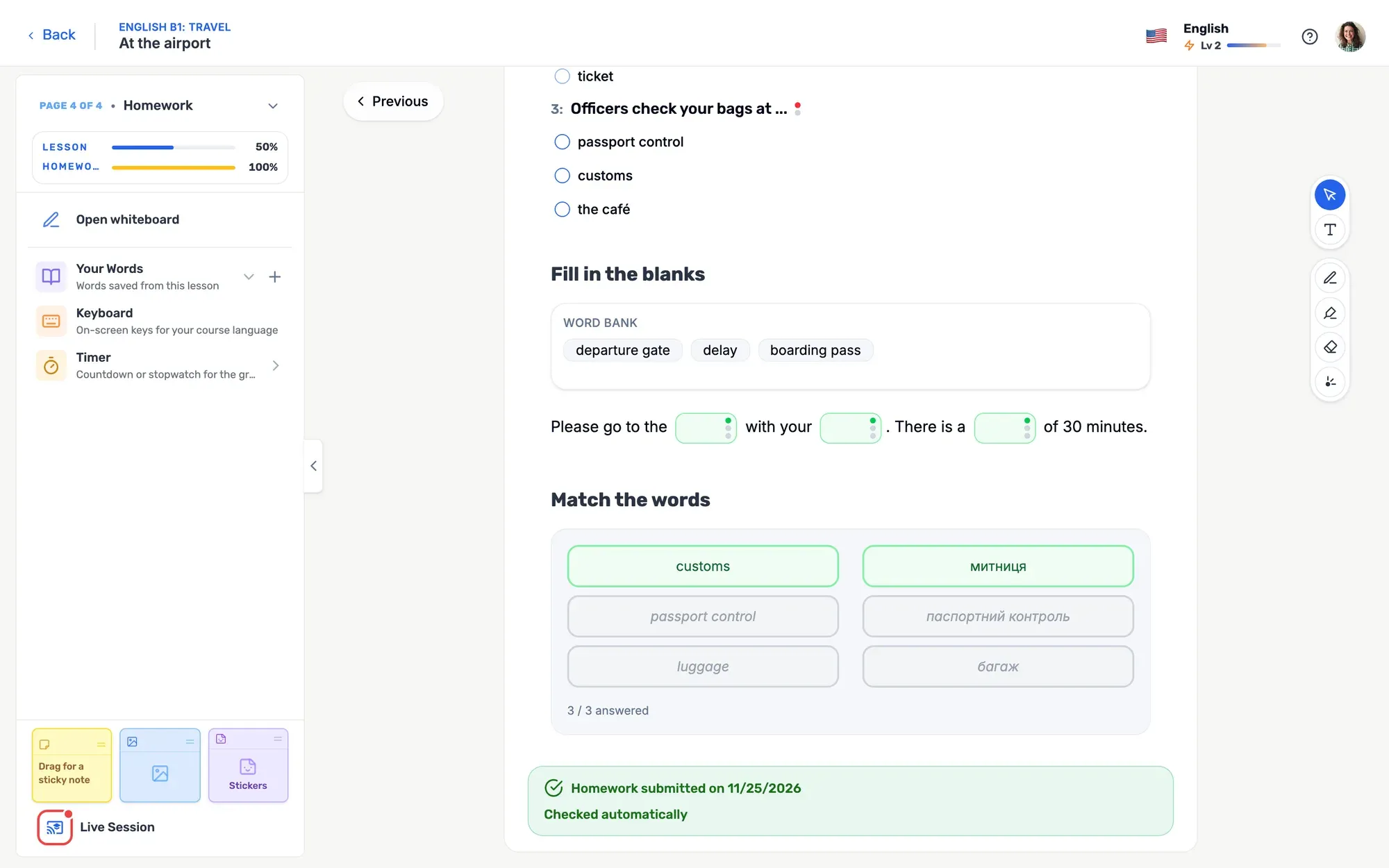
On verbios, when homework consists only of exercises with correct answers, such as quizzes, fill in the blanks or matching, it is checked automatically as soon as the student hands it in, and the student sees the result right away. Essays, recordings and exercises without marked answers still wait for you, and you can always review or send back automatically checked homework. More in homework that checks itself.
Closed exercises are checked the moment the student hands in
The feedback loop
Homework only teaches when something comes back. The feedback does not need to be long. Three kinds work well:
- Marked and fixed. For closed tasks, the result is the feedback. Spend two minutes at the start of the lesson on the three questions most students got wrong.
- One comment on an open task. Name one thing done well and one thing to fix, not twelve corrections. For writing, see error correction and writing feedback.
- Send it back. If the work is not good enough, say what to redo and let the student resubmit. In verbios you can send homework back with a comment explaining what needs redoing, the student sees it on their homework page and can resubmit, and each round is kept on the record.
A student who receives feedback two days after submitting will do the next piece. A student who never hears anything will drift.
Review homework at the start of the lesson
The first five minutes of the lesson are the best place for homework, and many teachers skip it. If you do not discuss the homework, you tell the student that it did not matter.
A five-minute review structure:
- Warm-up from the homework. “Read me your favorite sentence.” For voice tasks, play ten seconds.
- Fix the common mistakes. Write two or three of the sentences with errors on the board, anonymously, and ask the student to correct them. For a group, this is a natural step.
- Link to today. “Yesterday’s sentences were about the past. Today we use them to tell a longer story.”
If a student did not do the homework, do not lecture. Give them five minutes to do a short version at the start, and then continue. They lose five minutes of the lesson, which teaches them more than a speech would.
Common mistakes
- Giving homework only when you remember. Make it routine, even if it is tiny.
- Too much, once. One long weekly task is easier to skip than four 10-minute ones.
- Marking everything yourself. You will burn out, and the feedback will arrive late.
- Never changing the type. Alternate between listening, writing, speaking and closed practice.
You may find it easier to plan lessons and homework together, see plan a lesson fast, and to link the first homework to the trial lesson, see first online lesson with a new student. Sending homework to your own students starts on the Starter plan, which has a 7-day free trial (see pricing).
Frequently asked questions
How much homework should I give a language student?
Less than you think. For an adult with a job, 15 to 20 minutes between two weekly lessons that they actually do beats an hour they skip. For children, ask the parent what is realistic, and keep tasks short enough to finish in one sitting.
What should I do when a student never does the homework?
Treat it as information. Ask what got in the way (time, unclear task, boredom, too hard). Then shrink the task until it is done, even if it is five minutes. Habit comes before volume.
Should I mark every piece of homework?
No. Let exercises with one right answer be checked automatically and spend your time on the tasks that need a human: writing, speaking, and anything where the reasoning matters.