First online lesson with a new student: a plan that works

The first lesson decides more than any later one. The student is deciding whether to keep paying you, and you are deciding what to teach them. Most teachers make one of two mistakes: they run a formal test that makes the student feel examined, or they teach a full lesson on a random topic and learn nothing about the person. A better first lesson does three jobs at once. It finds out what the student needs, it places them roughly on the CEFR scale, and it gives them one small thing they could not do 20 minutes earlier.
Here is a plan for a 45-minute trial. Stretch it to 60 if you want, but do not squeeze in more.
Before the lesson: ask two questions, not twenty
Send a short message the day before. Ask only what changes your preparation:
- Why do you want English now? (a job interview, relocation, school, travel, a child’s grades)
- What have you tried before, and what did you dislike?
A parent booking for a 9-year-old will tell you about school marks. An adult who says “I freeze in meetings” has given you the whole syllabus in one sentence. Do not send a long questionnaire. People skip it, and the ones who fill it in write what they think you want to read.
Prepare one shared document or page with three levels of material on one topic, for example “my weekend” or “my job”. You will pick whichever level fits once you hear the student speak.
Minutes 0 to 10: needs analysis as a conversation
Begin with ordinary talk, in English if the student can manage it, in Ukrainian if they cannot. Starting in English with a beginner is not brave, it is stressful. A first sentence you can use at any level: “Tell me a bit about yourself, and about where you use English or want to.”
Then ask the questions a needs analysis really needs, one at a time, and write the answers down:
- In which situation do you most need English in the next six months?
- What goes wrong in that situation? (understanding speech, finding words, grammar, nerves)
- How much time can you realistically spend between lessons?
- What kind of lessons did you enjoy at school or with a previous teacher?
The third question is the most underrated. A student who can give 15 minutes a day needs a different plan from one who can give 15 minutes a week, and you should know this before promising results.
Minutes 10 to 25: check the level without a test
A formal placement test belongs to a school intake, not to a trial lesson with one tutor. Instead, use three tasks of rising difficulty on a topic the student picked, and watch where the language breaks.
Task 1, description (A1–A2). “Describe your morning.” Listen for present simple, routine vocabulary, whether sentences are complete.
Task 2, narration (B1). “Tell me about the last time you traveled or had a day off that went wrong.” This asks for past tenses, linking words and some vocabulary range. A student who stays in present simple with “yesterday” in the sentence is probably A2.
Task 3, opinion (B2). “Some people say online lessons are better than classroom lessons. What do you think?” Listen for modals of speculation, complex sentences, and whether the student can disagree politely.
You are not marking mistakes. You are noting three things: how long the student speaks without a pause, which structures come out automatically, and where they stop and switch to Ukrainian. Then compare what you heard with the CEFR descriptors for speaking. Two bands are enough (“solid A2, trying B1”).
A common mistake is to correct every error in this phase. Do not. A student who is corrected in minute 12 stops taking risks, and you lose the sample of language you came for. Take notes and correct two or three things at the end.
Minutes 25 to 40: a mini-win
Now teach something. Pick one thing from your notes that is small, useful for the student’s stated goal, and fixable in 15 minutes.
- A student who needs English for work and froze in meetings: three phrases for buying time (“Let me think about that for a second”, “Could you repeat the last part?”, “What I mean is…”) practiced in a two-line role-play.
- A student at A2 who can’t talk about the past: the pattern “I went to… and I saw…” with five questions they answer about their own last holiday.
- A 10-year-old: a short game, such as guessing an animal from three clues, using the exact words you saw were missing.
The test of a good mini-win is that the student uses the new thing on their own, in a sentence about their own life, before the lesson ends. Teach it, let them try it, correct it once, let them try again. If you use a shared page, put the three phrases or the pattern on screen so the student can see them and later copy them. A plain shared document does the job here too.
Minutes 40 to 45: set expectations and agree on the next step
Say out loud three things:
- Where you think they are (“You are around B1 for speaking, and your listening is stronger than your speaking”).
- What the first month will focus on, in one sentence.
- What you need from them: lesson time, a short task between lessons, and how to reach you.
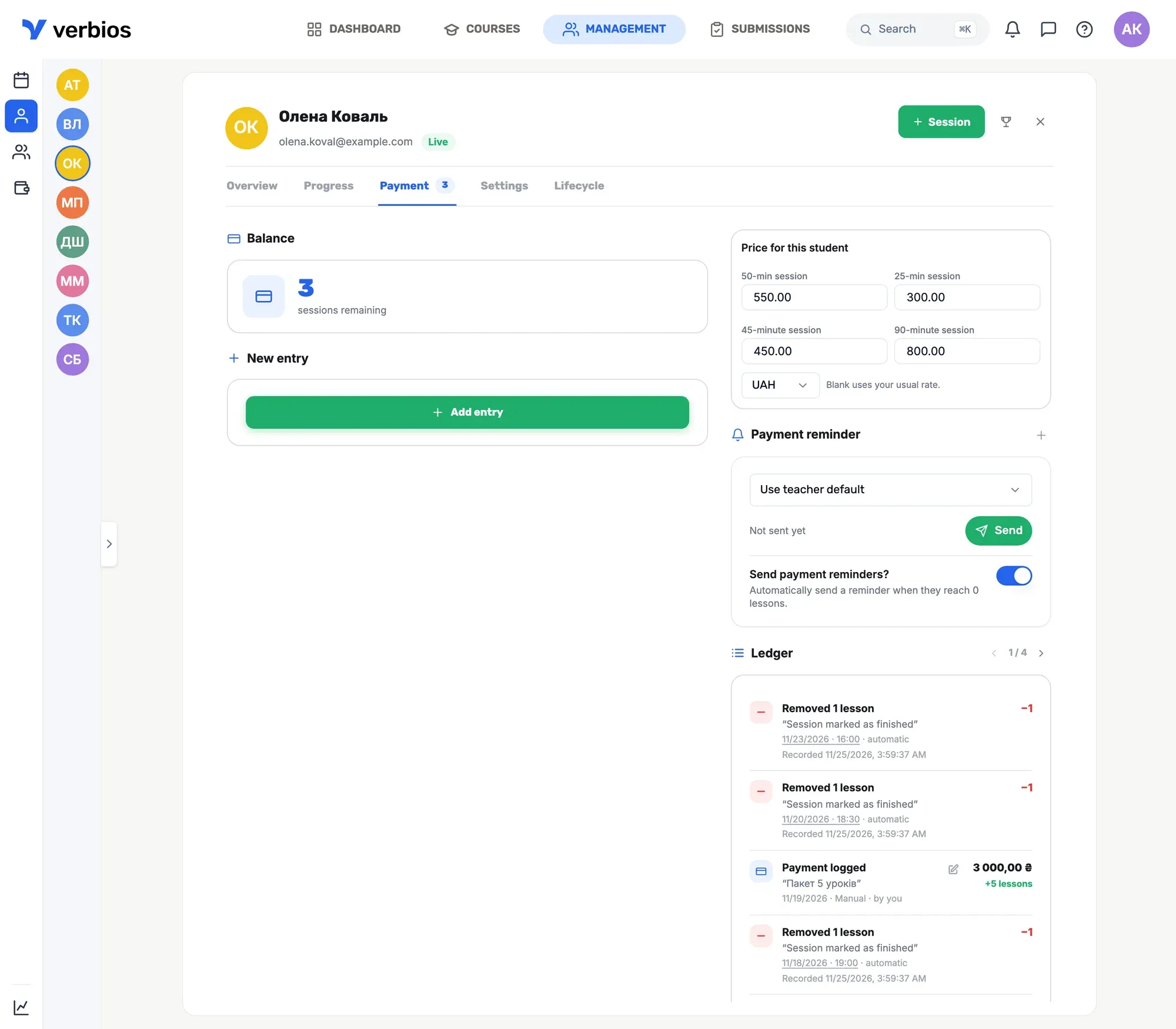
Then offer a concrete next step, not “let me know”. “I can offer Tuesdays or Thursdays at 18:00. Which works better?” A student who has to make a decision is more likely to book than one who is told to think about it. If you take payment through a link, send it now, while the lesson is fresh. How you structure recurring bookings and payments is covered in running a tutoring business.
What to send after the lesson
Within an hour, send a short message with:
- the three phrases or the pattern you taught, written out
- one tiny task due before the next lesson (five minutes, not twenty)
- the proposed times and the price, once more
- a line with what you noticed, such as “your listening is ahead of your speaking, so that is where we will start”
The message does a second job: it proves you listened. Students rarely remember what you taught, but they remember whether you remembered them. For ideas on what the first homework should look like, read homework students actually do, and for how to keep the second lesson as strong as the first, how to keep students engaged online.
Common mistakes in a first lesson
- Talking too much. Your voice should fill less than half of the lesson. A trial where you explain your method for 15 minutes teaches the student nothing about English.
- Testing instead of listening. A grammar test of 40 questions tells you what the student has memorized, not what they can do.
- Promising results with a date on them. “You will speak fluently in three months” cannot be kept. “If you practice twice a week, in three months you should manage a ten-minute conversation about your job” can.
- No mini-win. If the student leaves with nothing new, the lesson felt like an interview, and an interview is not a reason to pay.
If you teach on verbios
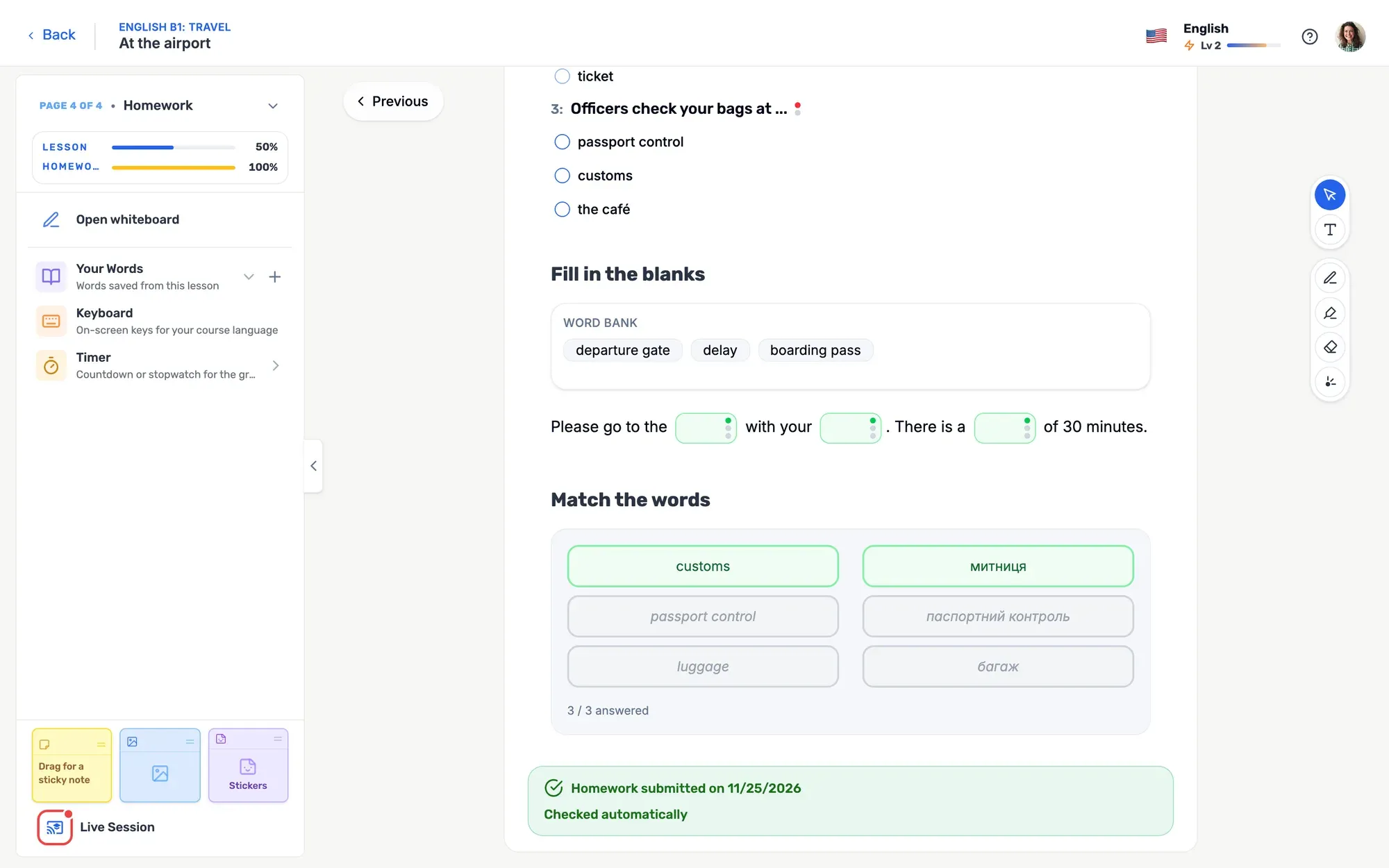
In a live lesson you and the student share the same lesson page, so you can put the level-check tasks and the three target phrases on screen and the student sees them while you speak. If you want the student to keep the phrases, words your teacher adds appear in the student’s own vocabulary, as described in the learner’s dictionary post; the same idea is in how to teach vocabulary so it sticks. Live lessons start on the Starter plan, which has a 7-day free trial (see pricing).
Frequently asked questions
How long should a trial English lesson be?
Thirty to forty-five minutes is enough. Short enough that a nervous student does not tire, long enough for a conversation, a level check and one small result. If you teach 60-minute lessons, a shorter trial is normal and easy to explain.
Should a trial lesson be free?
That is your business decision, and both work. What matters is that the student leaves with something concrete and a clear next step. A free or discounted trial lowers the barrier, a paid one filters for serious students. Decide once and say it plainly before the lesson.
How do I check a student's level without a formal test?
Talk first, then give two or three tasks of rising difficulty on a topic the student chose. Listen for how long they speak, which tenses they use without thinking, and where they stop. Map what you hear to CEFR descriptors, not to a test score.