How to teach vocabulary so students actually remember it
Every teacher knows the scene. You taught “luggage” and “delay” on Tuesday, the student nodded, did the exercise perfectly, and on Thursday has no idea what “delay” means. The word was understood, it was never learned. The good news is that this is mostly a question of how words are practiced, and a few habits fix most of it.
Recall beats re-reading
The most reliable method for remembering words is retrieval practice: pulling a word out of your head makes it stronger than seeing it again. Trying to remember, even when you fail, does more for long-term memory than re-reading the same list.
In class this means you stop showing the translation and ask for it. Instead of “luggage means багаж”, cover the card and say: “What do you call the bags you take on a plane?” Let the student struggle for a few seconds before you help. A few quick ways to do it:
- Flash the Ukrainian word and ask for the English one, then flip it the next day.
- Give the first letter and the number of letters (“l _ _ _ _ _ _ _, eight letters”).
- Describe the word in simple English and let the student guess it (a definition game works from A2).
- Ask a question that can only be answered with the target word: “What do you pay when you take too much luggage?”
Keep these as short warm-ups, three to five minutes at the start of the lesson. A student who has to produce yesterday’s words before you teach new ones is practicing retrieval without noticing it.
Space it out instead of cramming
The forgetting curve is the observation that new information fades fast unless you return to it. Spaced repetition uses this: review a word just as it starts to slip, then again after a longer gap. A common rhythm is the next day, then three or four days later, then a week or two later. You do not need exact numbers, only the principle that the gaps grow.
A teacher can build this by hand with a simple rule: every lesson opens with words from last lesson, and every fourth lesson opens with words from a month ago. Keep a running list per student, with the date each word was taught, and tick words as they survive each review. A word the student gets wrong goes back to the start of the ladder.
In practice, the list is the hard part. Tutors with fifteen students cannot hold fifteen lists in their head. This is the one place where tools genuinely help, which is why the saved words in verbios carry a status (Learning, Learned, Mastered or Trouble) and come back for review automatically. More on that below.
Teach words in context, not in isolation
A word learned alone is hard to use. A word learned with its neighbors is easier to remember and to say. Collocations are the natural pairs: “make a decision”, not “do a decision”; “heavy rain”, not “strong rain”. Ukrainian speakers get tripped up by exactly these, because the pair in Ukrainian differs.
Some habits that help:
- Teach the chunk, not the single word. “Check in” at an airport, “catch a flight”, “miss a connection”.
- Show the word in a real sentence from the lesson text, then ask the student to build their own about their own life. “I missed my train because…” is far more memorable than a sentence from a worksheet.
- Note the part of speech and one common partner. “Delay (noun): a long delay, flight delay. Delay (verb): the flight was delayed.”
- Put the word in a small story. Two or three connected sentences are easier to recall than three unrelated ones.
For a B1 class, a good five-minute task is this: give six words from the unit and ask each student to write three sentences that use at least two of the words together. Read a few aloud and correct only the word usage, not the grammar.
Pictures, gestures and the first language
For concrete nouns and verbs at A1–A2, a picture is faster and cleaner than any explanation. For abstract words, an example situation does the same job. With younger learners, a gesture or action (“delay” as a pause gesture) gives the word a body. You can still use the first language: a quick Ukrainian gloss is fine for a hard word, as long as you then return to using it in English. Overusing translation turns every new word into a translation exercise, so use pictures and short definitions first and the Ukrainian word when a student is stuck.
One more thing: students remember words they chose. If a word comes from the student’s own reading or conversation, it matters to them. Ask them to flag any word they wanted to know during the lesson, and add those to the list as well as your planned ones.
Small daily goals
Fifteen minutes every day beats an hour on Sunday. The reason is the same spacing effect: short daily sessions give the memory many return visits. Ask students to do a small fixed amount, for example ten words a day, and make it easy to start. A goal that takes five minutes gets done. A goal that takes forty minutes gets skipped.
Tell students exactly when: “after you brush your teeth”, “on the bus”. Habits attached to existing habits stick better than good intentions. For kids, a parent reminder helps more than a teacher reminder.
Recycle words into the next lesson
The cheapest trick in this article. Plan one task in every lesson that forces last lesson’s words to show up again, in a new situation. If you taught travel words, the next lesson’s warm-up is “Tell me about the worst journey you have had” and you listen for the words. A student who uses “delay” naturally while talking about something else has learned it.
A simple lesson skeleton for 60 minutes that builds this in:
- 0–5 minutes: retrieval of last lesson’s words (no notes).
- 5–15 minutes: new words with context, pictures and collocations.
- 15–40 minutes: main activity (reading, listening, speaking) in which the words are needed.
- 40–50 minutes: production task, a short writing or speaking task using the new words.
- 50–60 minutes: students pick the words they want to keep, and you set the daily goal.
If you teach groups, see teaching online groups for ways to keep everyone producing, and speaking practice ideas for activities that recycle vocabulary.
Where verbios takes the admin out of this
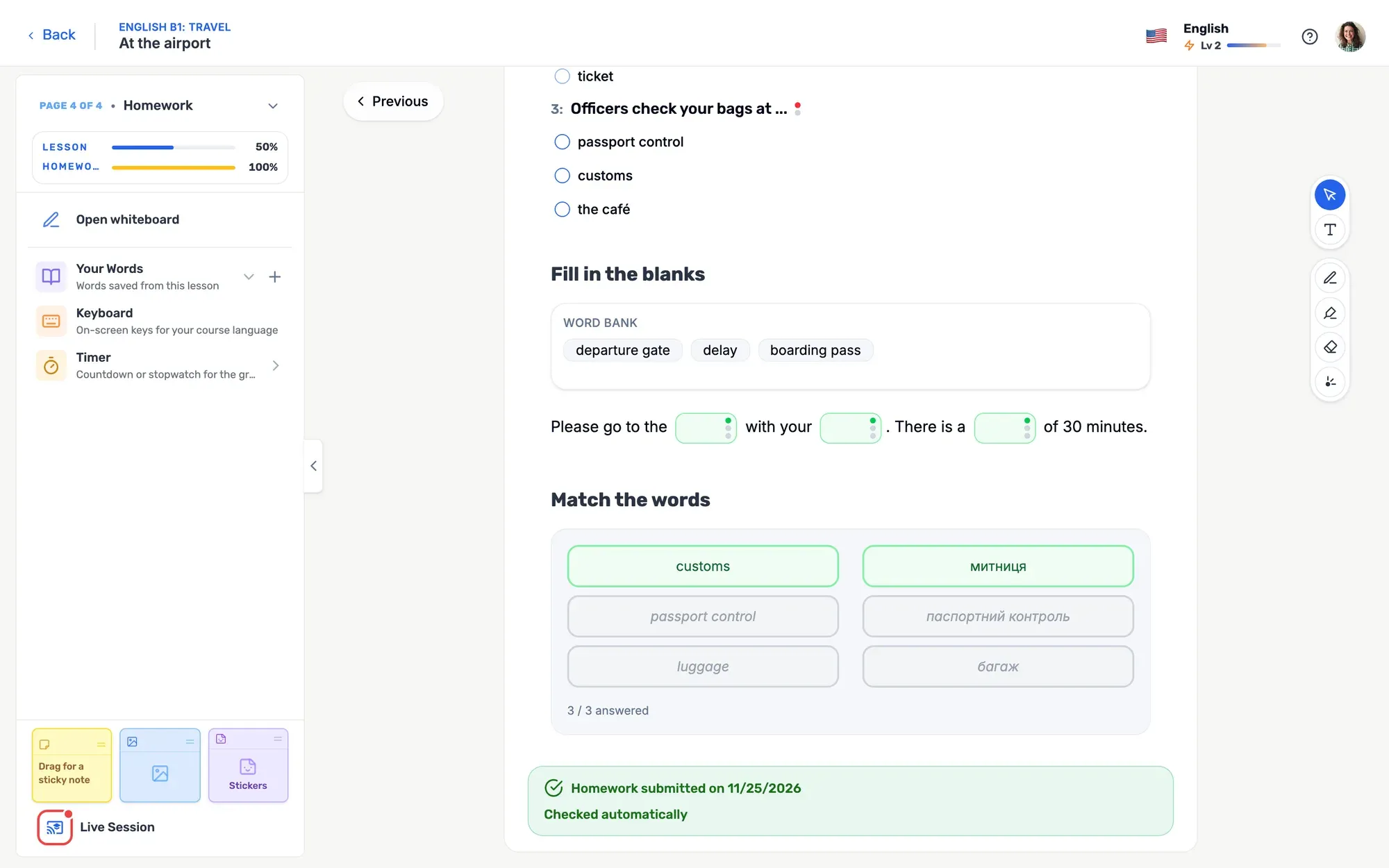
While a student reads in a verbios lesson, they can highlight any word and see a definition and pronunciation in the built-in learner’s dictionary (English only for now), then save it with one click. Saved words land in the student’s own list, and you can add words during a live lesson too. See the learner’s dictionary for how lookup works.
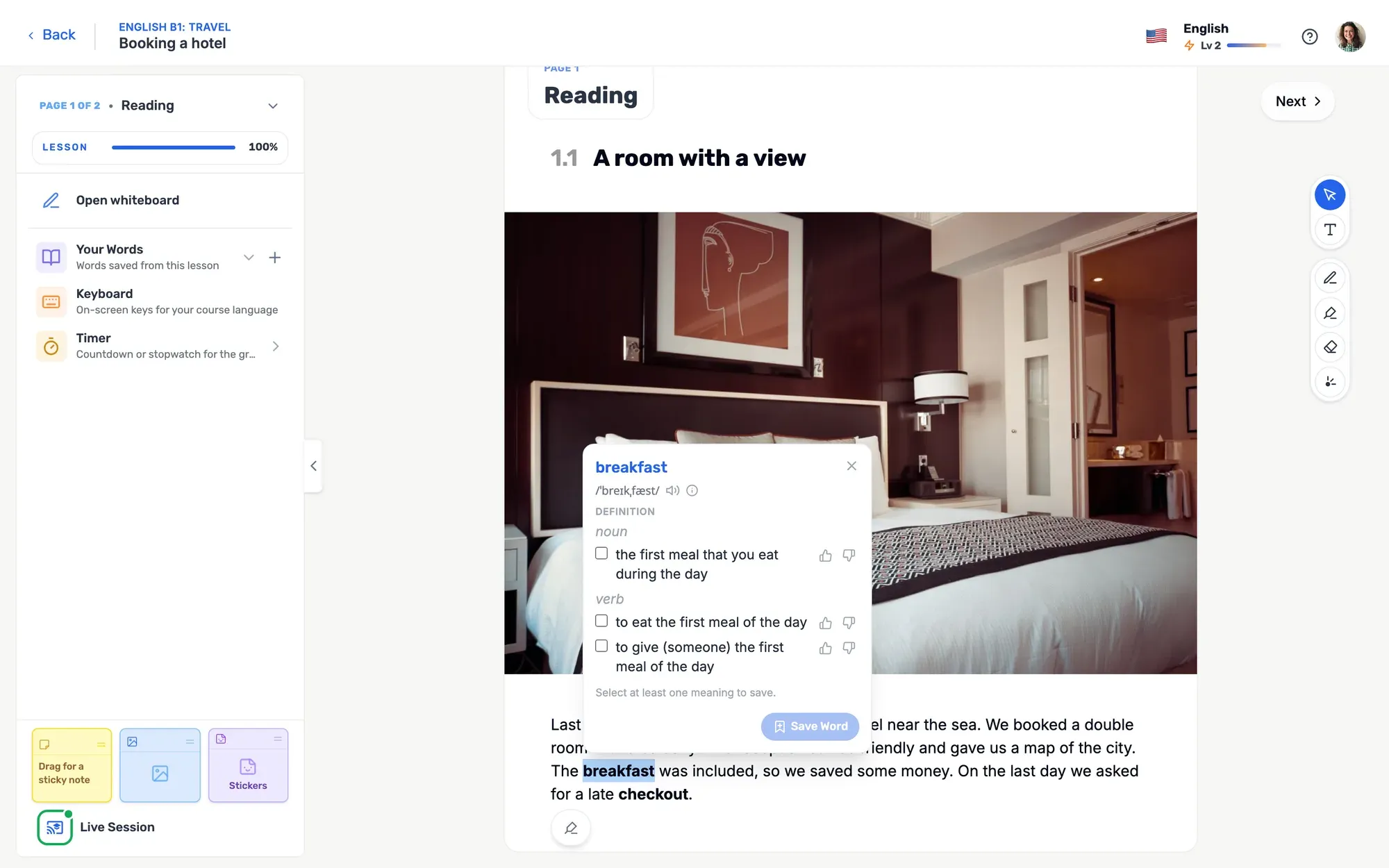 Highlight a word in a lesson, pick the meaning, save it.
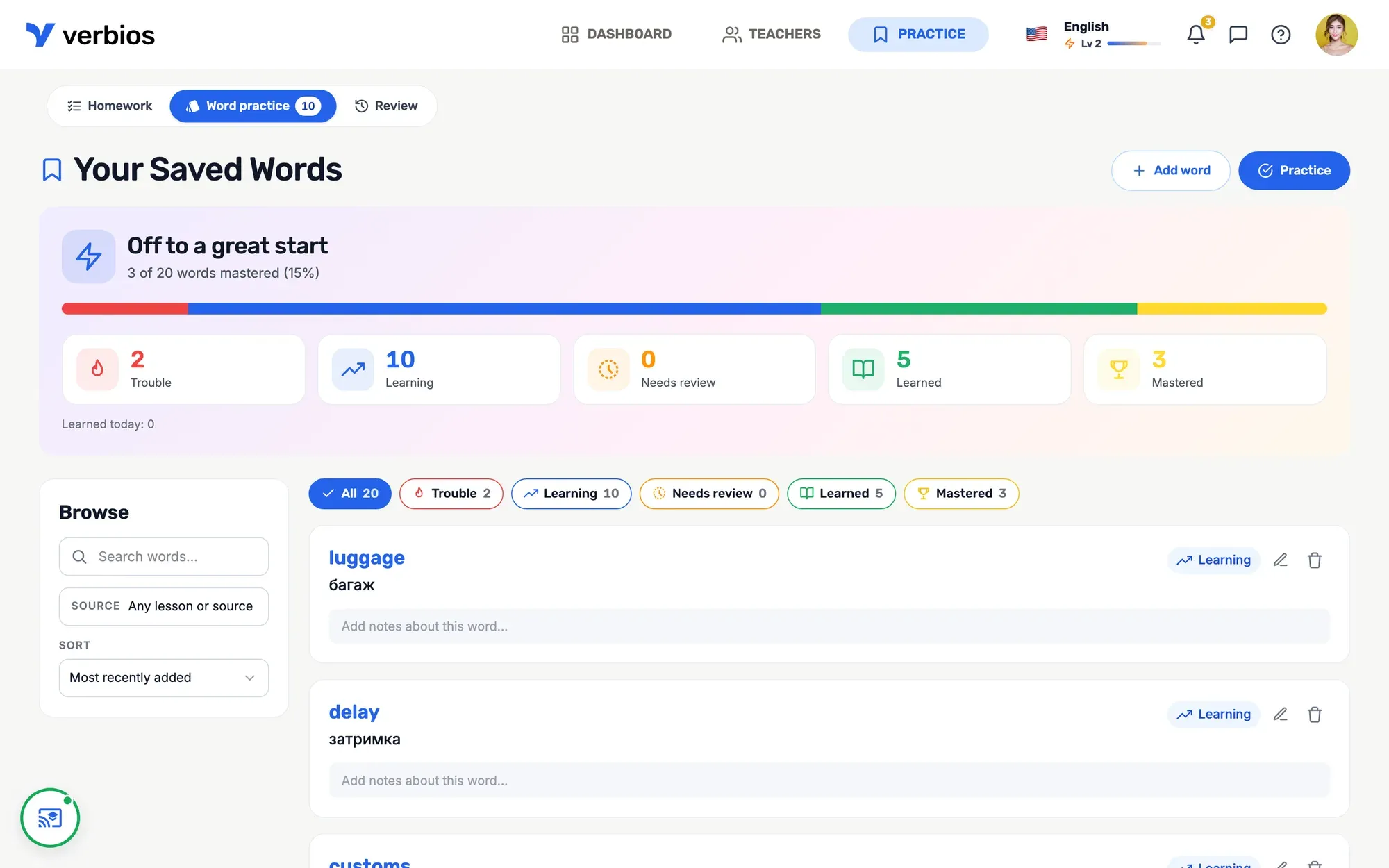
The student then practices from a picker with three modes: Guided (from flashcards up to typing the word), Random, or a single exercise of their choice. Each saved word has a status, Learning, Learned, Mastered or Trouble. Two clean sessions in a row move a word from Learning to Learned, and Learned words need four clean reviews on different days to become Mastered. There is also a daily goal of ten words per language. In other words, spaced repetition runs by itself, and you spend lesson time on using words, not on keeping lists. More in word practice.
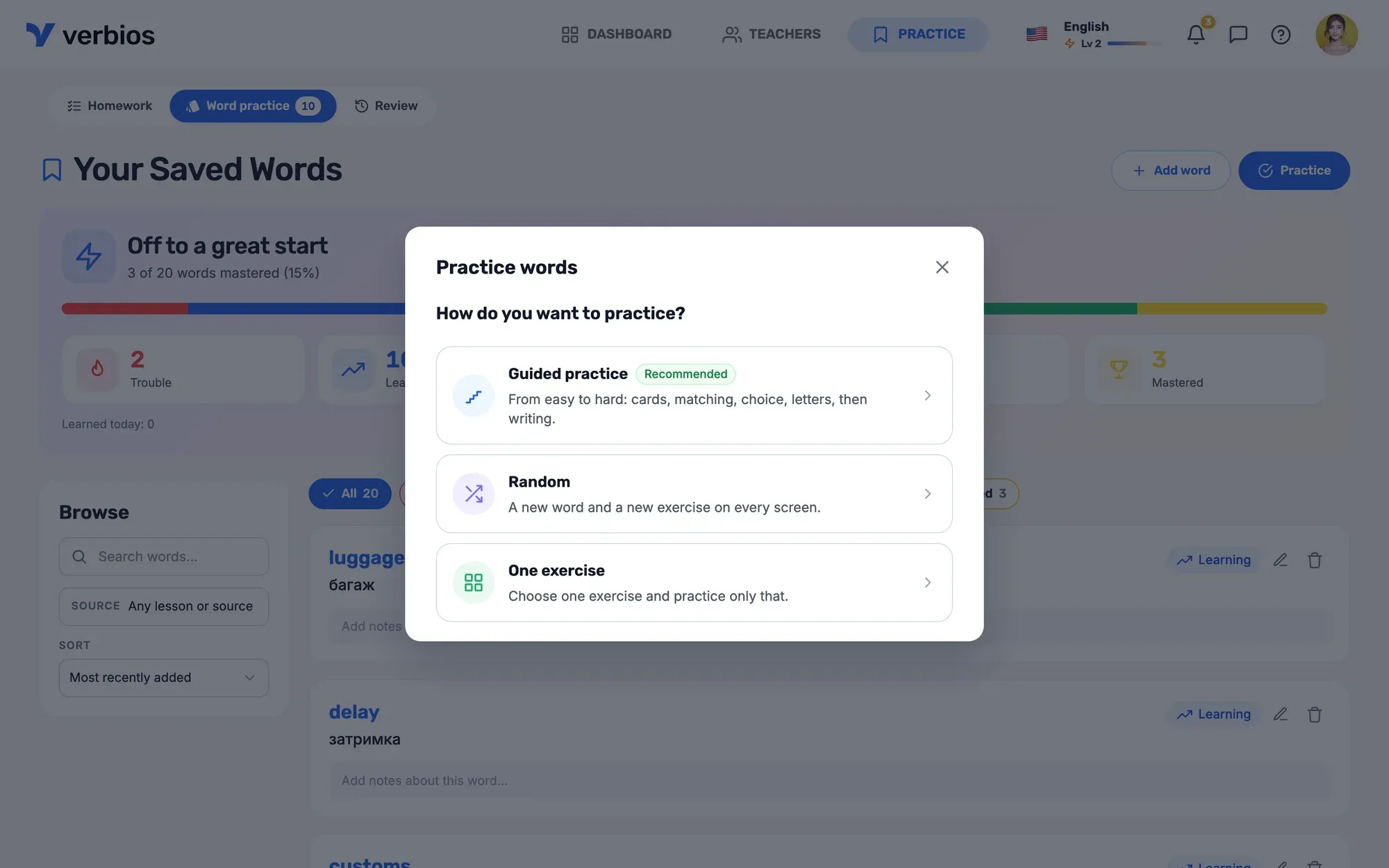 Three ways to practice the saved words.
If you want to try it with your own students, the pricing page shows what each plan includes.
Common mistakes
- Teaching too many words and never returning to them. Fewer words, revisited more often, beats a long list seen once.
- Testing recognition only (“which of these means luggage?”) and assuming the student can produce the word.
- Giving a translation every time, so the student never has to think in English.
- Leaving vocabulary out of the lesson plan, so words come up only by accident.
For the writing side, see error correction and writing feedback to turn the same words into useful feedback.
Frequently asked questions
How many new words should I teach in one lesson?
Five to eight words in a 45–60 minute lesson works for most learners, with more time spent using them than presenting them. Younger learners and A1 students often do better with fewer. If your students recognize words but cannot use them, teach fewer and recycle more.
What is spaced repetition in simple terms?
It means reviewing a word at growing gaps: soon after you learn it, then a few days later, then a week or more later, instead of cramming it many times in one sitting. Each review is timed for when the word is starting to fade, which makes the memory stronger.
Should students write translations or definitions?
Both have a place. A native-language translation is quick and clear for concrete words at A1–A2. From B1 onward, short definitions and example sentences in English help students think in the language and notice how a word is used. Pairing the two on one card works well.