Teaching online groups: how to run small group lessons
A good group lesson online is harder than one-to-one, and not because of the technology. In a one-to-one lesson, a quiet student has nowhere to hide. In a group of five, three of them can go through an hour without saying anything meaningful. Add a lag in the audio, a student who is also cooking, and one who answers every question first, and you can run a whole lesson without most of the group learning anything. The fixes are structural. You change how questions are asked, not how you feel about the students.
Everyone answers at once
The default group question is “Who can tell me…?” It rewards the fastest and most confident student and invites the rest to relax. A better habit is to ask a question that everyone must answer, in the same minute.
Three ways to do it:
- Write first. “Everyone write one sentence about your weekend in the chat. Don’t send yet. Send on three.” Then everyone has committed to an answer, and you read two or three aloud.
- Show a choice. “Is this sentence correct? A, B or C?” Everyone holds up a finger, or types the letter. You see at once who is guessing.
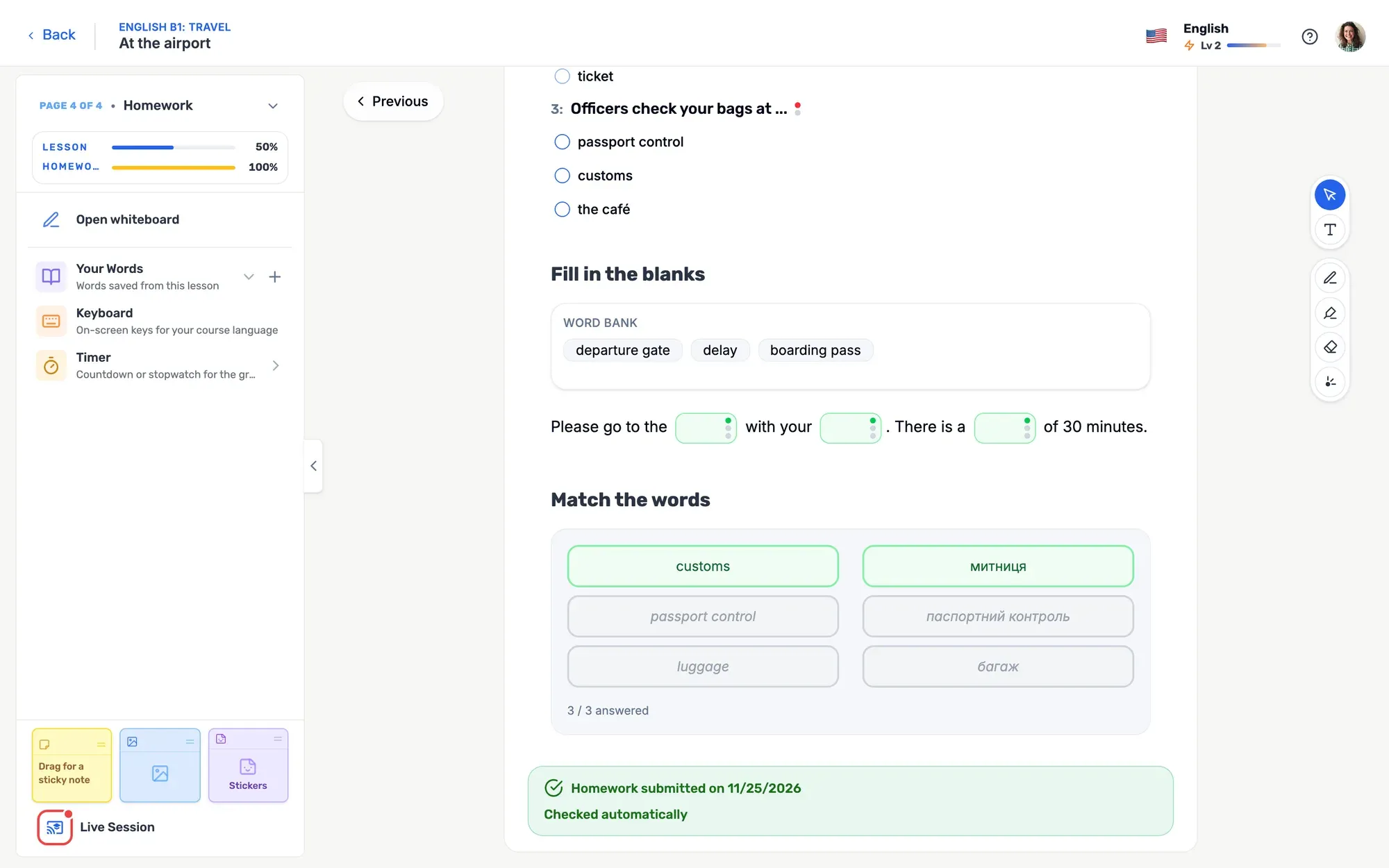
- Answer on a shared page. If the students can type into the same exercise at the same time, you see the whole group’s answers as they appear. You do not need to wait for each person to speak.
The aim is the same in all three: every student produces something, and you get information on every student, not just the loudest one. Then you pick two or three answers to discuss, and nobody feels tested in front of the others, because everyone answered.
Pairs and breakouts
In a whole-group discussion with five students, each student speaks for only a small slice of the time. In a pair, each gets half. Pairs multiply speaking time, and for shy students a pair is much less frightening than the group.
You can do this with breakout rooms if your video tool has them. If it does not, or if the group is small, you can use a simpler structure:
- Students 1 and 2 talk while 3 and 4 listen and note two mistakes or good phrases. Then swap.
- One student interviews another with questions from the page, and you listen to one pair at a time and move on after two minutes.
When using breakouts, give the pair a clear task and an outcome, such as “Decide together which three places to include in the trip. You’ll report back in four minutes,” not “talk about travel.” Tell them how long they have. Come back with a question that forces both students to speak: “Anna, tell us what Max decided.”
What to avoid: leaving pairs alone for 15 minutes with no outcome. They will drift into Ukrainian or small talk, and you cannot see it.
The quiet student and the dominant student
The quiet student. First find out why. A student can be silent because of low confidence, because the level is too high for them, because they are bored, or because the connection is bad. The first two are the most common. Make it feel safer:
- Ask them last in a round, so they have heard the model answer.
- Let them write before they speak.
- Ask questions that only they can answer: “What did you do on Saturday?” instead of “What is the past tense of go?”
- Praise one specific thing they said (“Good use of used to”), not “good job.”
The dominant student. This student is usually keen, and not rude. They fill the silence because silence is uncomfortable. Handle it by changing the structure:
- “Let’s hear from someone who hasn’t spoken yet.”
- Name the order: “Olena, then Pavlo, then Maksym.”
- Give the dominant student a different role: they listen to the answer and ask a follow-up question.
- Use writing first. A student can’t dominate a chat where everyone writes at once.
Avoid public reprimands. You can talk to the dominant student alone after class, and often it is enough to say, “I want the others to speak more, can you help me by letting them answer first?”
Live quizzes as checks, not tests
A short quiz inside a lesson is the quickest way to see what the group understood, if it is handled as a check and not as an exam. The point is the information, not the score. After five to eight questions, you know which structure to reteach and which can be dropped.
How to run one:
- Put the quiz after you teach something, not at the end of the hour. If a question is missed by half the group, reteach it right away.
- Keep it to five to eight questions, about five minutes.
- Read out the answers and talk about why the wrong options are wrong. The wrong answers are where the teaching is.
- Play down the ranking if the group is sensitive about being last. Highlight the questions the group found hard.
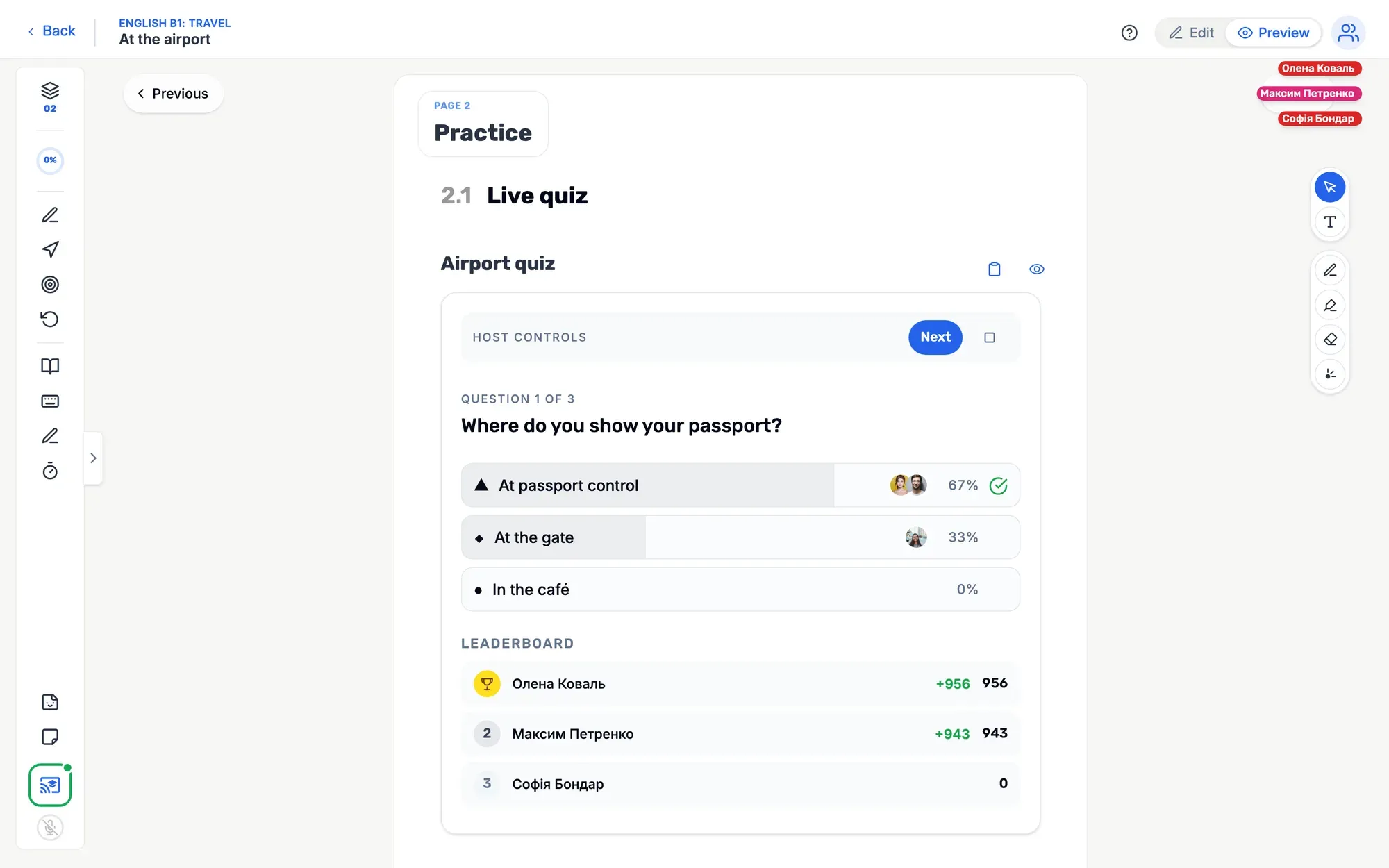
In verbios, a teacher can run a synchronized quiz block during a live lesson and see every student’s answers in real time, so you can tell at a glance which option attracted the group. The live quiz for groups post describes how it works.
The teacher sees each option's share of answers as they come in
A 60-minute group lesson (B1, five students)
| Minutes | Activity |
|---|---|
| 0–8 | Warm-up: everyone writes two sentences about their week, you read some out |
| 8–20 | New language: you present, students try sentences on a shared page |
| 20–35 | Pair work with a task and an outcome, then report back |
| 35–42 | Live quiz: six questions on the new language |
| 42–55 | Reteach what the quiz showed was weak, then a freer speaking round |
| 55–60 | Each student says one thing they will use this week; you set the homework |
The pattern is the same everywhere: answer, produce in pairs, check, correct. Notice that the teacher speaks in short blocks and nobody waits more than a few minutes for something to do.
Common mistakes
- Keeping a whole-group Q&A running for 20 minutes. Two students will answer. Three will not.
- Praising the fastest. The quick student learns that speed is rewarded, and the slow ones stop trying.
- Mixed levels without a plan. If the group has a B1 and an A2 student, give different roles in the same task, not different tasks. The A2 student describes, the B1 student asks follow-up questions.
- No shared record. After the lesson, students should be able to find what was on the board. In group lessons on verbios, notes, picture marks and the whiteboard you use during a group lesson go to the whole group, including students who missed the lesson.
For attention across the lesson, read how to keep students engaged online. For homework that fits a group, see homework students actually do. Live group lessons start on the Starter plan, which has a 7-day free trial (see pricing).
Frequently asked questions
How many students is too many in an online group?
For language lessons where students speak, four to six is the best size and eight is the limit. Beyond that, each student gets so little speaking time that a group lesson stops being a speaking lesson.
How do I get a quiet student to speak in an online group?
Make answering feel safer before you raise the demand. Let them answer in writing first, ask them in a pair before the whole group, and give a question they can answer with information only they have, such as their own opinion or experience.
How do I stop one student from dominating the lesson?
Change the rule, not the person. Use turn-taking structures: everyone writes an answer first, you call on students in an order you choose, or the answer must build on what the previous student said.