How to plan an English lesson fast: a reusable skeleton
Most tutors do not run out of ideas. They run out of evenings. If you teach six to eight hours a day and then spend another hour building tomorrow’s lesson from a blank page, the plan is the problem, not you. The fix is a skeleton you reuse, parts you build once, and a clear rule for what a draft has to pass before a student sees it.
A five-part skeleton for a 60-minute lesson
Almost every good language lesson can be described by the same five parts. Use these timings as your default split. For a 45-minute lesson, trim the middle sections proportionally.
| Part | Minutes (60) | What happens |
|---|---|---|
| Warm-up | 5 | Activate what students already know, get them speaking |
| Input | 10–15 | New language or a text, audio or video that contains it |
| Controlled practice | 15 | Exercises with one right answer, high accuracy |
| Freer practice | 15–20 | Students use the language for a real task |
| Wrap-up | 5 | Review, a quick check, homework |
This is close to the old PPP (presentation, practice, production) shape, and you can adjust it. If you prefer task-based teaching, put the freer task first, watch what students struggle with, and then do input and controlled practice on exactly that gap. The five parts stay the same; only the order moves.
Warm-up: five minutes, no new material
Ask something that is easy to answer and connects to the day’s topic. For a B1 lesson on travel: “What was the last place you went to for more than two days? One thing that went wrong?” A warm-up also works as retrieval practice: “Tell me three words from last lesson without looking at your notes.” Pulling something out of memory helps it last longer than rereading it, so this costs you almost no planning and pays back.
Input: one idea, not five
Choose a single target: one grammar point, or one set of 6–8 words, or one functional phrase set (“making and declining invitations”). Present it inside a short text or a dialogue rather than a list. Students should meet the language in context, and ideally at a level slightly above their own, so that most of it is understandable and a little is new (comprehensible input).
Controlled practice: where accuracy is built
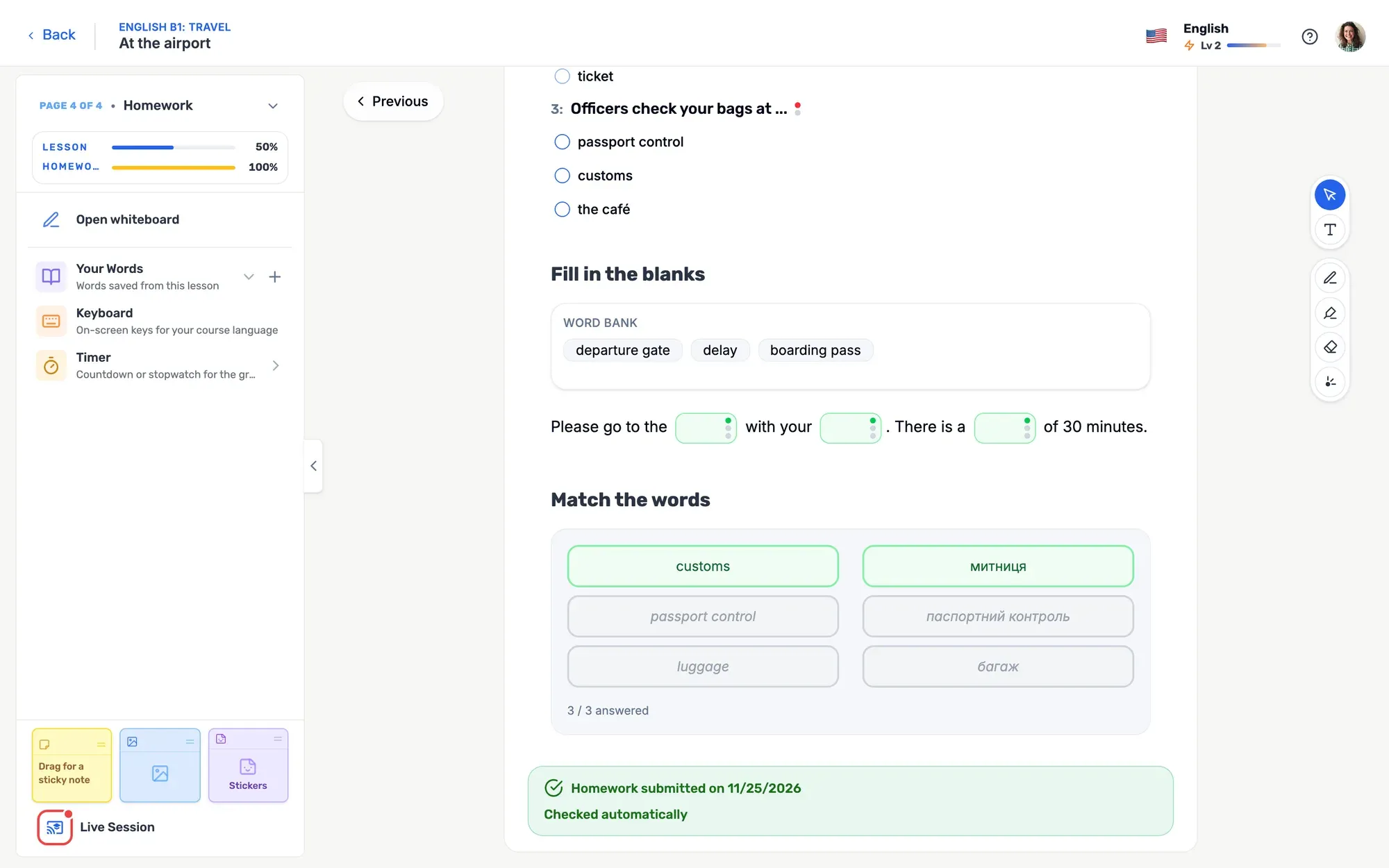
Matching, fill in the blanks, choosing the right form, reordering words. The point is quick, repeated, correct use. A good test: can the student do these without you saying anything? If they can, they are ready for the next part. If not, you have found out something useful and can go back one step.
Freer practice: the part students remember
A role-play, a short discussion, a message to write: “Your flight is canceled. Call the airline and ask for a new flight.” Give a clear outcome and a time limit. While they speak, write down errors on the side instead of interrupting, and deal with two or three at the end (see our guide on error correction and writing feedback). If you spend more than half the time in this part talking yourself, shorten your instructions.
Wrap-up
Ask for one thing learned (“Tell me two new phrases you will use this week”), give the homework, and note what to revisit next time. That note is the seed of the next plan.
Build once, reuse many times
The biggest time saver is separating what stays fixed from what changes per student.
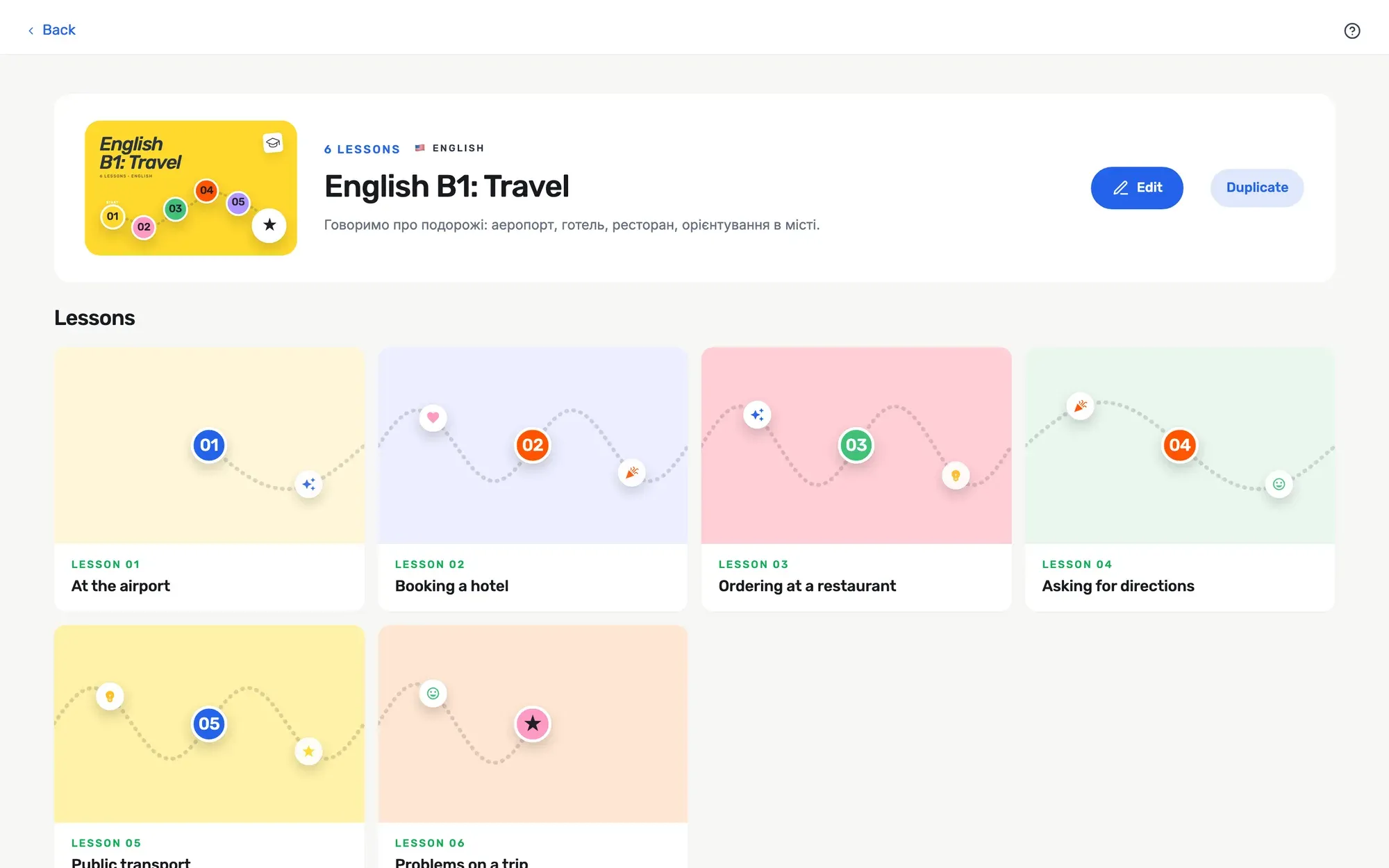
- Keep a lesson library by level and topic. “B1: Travel, at the airport”, “A2: Daily routine”, “B2: Opinions and agreeing/disagreeing”. Each lesson already follows the skeleton.
- Personalize in five minutes. Swap the examples, the role-play situation and two or three vocabulary items to fit the student’s job, hobbies or exam goal. The structure does not change.
- Keep reusable blocks. A warm-up question bank, a set of standard role-play cards, a wrap-up template. You will use these dozens of times.
- Write the next plan before the lesson ends. Two lines in a notebook are enough: “revisit past simple irregulars, start unit on opinions”.
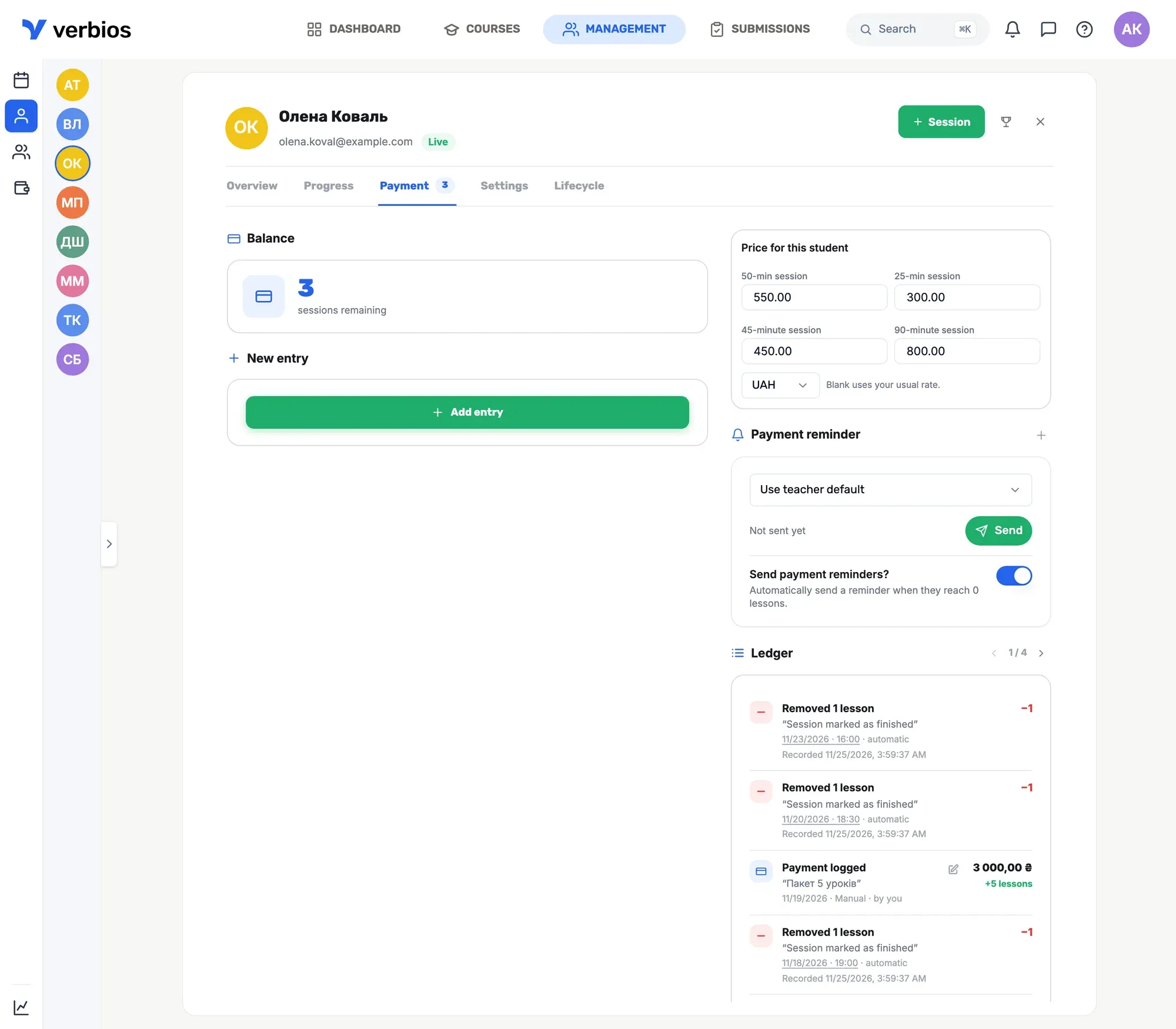
If you teach in verbios, courses and lessons are the library, and a lesson can be copied and edited per student, so a repeat lesson takes minutes. If you already have exercises in other tools, the import of Wordwall, LearningApps and Kahoot activities turns them into native exercises that check themselves, so your old materials do not have to be rebuilt by hand.
Using AI for drafts, responsibly
AI is good at the boring part: a first outline, 10 gap-fill sentences, a short dialogue at a given level, a word list for a topic. It is not good at knowing your student. Treat every output as a draft by a fast assistant who has never met them.
A prompt that works better than “make a lesson about travel”:
Plan a 60-minute lesson for one B1 adult student (works in IT, wants to speak more fluently). Topic: cancelled flights. Use five parts: warm-up, input, controlled practice, freer practice, wrap-up. Give timing for each. Dialogue 120–150 words, 8 words to learn, 10 gap-fill sentences with answers.
Then check four things before you use it:
- Level. Is the vocabulary and sentence length really B1, or has it crept up to C1? Read the dialogue out loud.
- Accuracy. Are the answers correct, and is there only one correct answer? Gap-fill sentences with two valid answers frustrate students.
- Cultural fit. Do the names, places and situations make sense for a student in Ukraine? A dialogue about tipping at a diner is fine only if it serves your goal.
- Fit to this student. Does it connect to something they care about, and does it avoid what they already know?
In verbios, the AI helper sits in the lesson builder: ask it to plan a lesson, it asks a few quick questions, shows a plan you can rearrange, and then builds the lesson page by page in your course’s language and level. You can also drop in a photo or PDF of a textbook page and ask it to turn the section into exercises. It is included in the Starter and Pro plans, and the same rule applies: it drafts, you check.
Common mistakes
- Planning too much input. One target per lesson is enough, and students forget the rest.
- No freer practice because “we ran out of time”. Cut input instead.
- Writing the plan around materials rather than around the outcome. Start from “by the end they can…”.
- Throwing away a plan after one use. Save it with notes on what worked.
For where to go next, see homework students actually do for the wrap-up part, and your first online lesson with a new student if you are starting from scratch. If you want to try this skeleton in a builder with ready exercise blocks, take a look at the verbios plans.
Frequently asked questions
How long should it take to plan one English lesson?
With a fixed skeleton and a library of reusable parts, 15 to 20 minutes for a new lesson is realistic, and a repeat of an existing lesson for a new student takes only a few minutes of adjusting. Planning from a blank page every time is what makes it take an hour.
Can I use AI to write my lesson plans?
Yes, as a first draft. Always check the level of the language, the accuracy of the answers and whether the topic and examples suit your student before it reaches the lesson.
Should every lesson follow the same structure?
The same skeleton works for most lessons, which saves planning time and helps students know what to expect. Change the proportions, not the order, depending on the goal of the lesson.