How to correct student mistakes: speaking and essay feedback
Correction is where teachers lose the most time and where students lose the most confidence. Mark everything in red and the student stops writing. Say nothing and the same mistake turns into a habit. Good feedback sits between the two, and it starts with deciding what the activity is for.
Fluency or accuracy: decide before you start
The single most useful distinction in correction is between accuracy activities and fluency activities. In an accuracy activity (a grammar drill, a gap-fill, a controlled practice sentence) the point is to get the form right, so correct on the spot. In a fluency activity (a discussion, a role play, telling a story) the point is to keep talking, so interrupting for grammar defeats the purpose.
Tell the student which mode you are in. “For the next five minutes I am listening to your ideas, and I will write down some things to look at afterwards.” That one sentence removes most of the anxiety around being corrected, because the student knows the mistakes are being collected, not judged.
Correct in speaking: four techniques
Recasts. You repeat what the student said, correctly, and move on. Student: “She don’t like coffee.” Teacher: “She doesn’t like coffee? What does she drink?” It is gentle and keeps flow, but learners often do not notice the correction, particularly when the recast is very natural. Use recasts for small slips, and not as your only technique.
Explicit correction. You say clearly that something was wrong and give the form. “We say ‘she doesn’t like’, not ‘she don’t like’.” This is fast and clear, and best for accuracy work and for errors the student keeps repeating.
Prompting (elicitation). You help the student fix it themselves. Repeat the sentence up to the error and pause (“She… ?”), or ask “Is that right?” or “One more time, third person”. This works well from A2 upward, because the student has to actively retrieve the form, and what they correct themselves they usually remember better.
Delayed correction. You note errors during the activity and go through them afterwards. The practical version: keep a page with three columns, “good language”, “to fix” and “new words”. During a speaking task, jot down a few real sentences the student produced (write them exactly as said, no names). When the task ends, put 3-5 of them on the board or in the chat. Ask the student first: “Which of these sentences has a problem?” Then fix them together. Include one or two good sentences, so the list is not only failures.
Pick no more than three to five errors for delayed correction. If you list fifteen, the student remembers none.
What to correct first
Start with errors that block understanding, then errors in the target language of the lesson, then errors that repeat across lessons. A missing article from a Ukrainian speaker does not stop communication. A wrong tense that changes the meaning does. Pronunciation of a single vowel rarely deserves an interruption, while a stress mistake that makes the word unrecognizable does.
Essay feedback students actually read
Written work gives you something spoken work does not: time. But the common pattern is to spend twenty minutes marking an essay and have the student glance at the grade. Some changes make feedback get used.
- Limit the focus. Choose two or three error types for this piece, for example articles and past simple, and mark those. Mention the rest in one line at most. Students can only act on a short list.
- Say something about the content first. “The story about your grandmother’s village was vivid” tells the student what to keep doing. Feedback that is all correction teaches students to write less.
- Mark, don’t rewrite. Underline the error and write a short code or a hint (“tense?”, “article?”) so the student fixes it. Rewriting the sentence for them removes the learning.
- Make revision part of the task. The student rewrites the corrected sentences or the whole piece and sends it back. If they never revise, they read the feedback once and forget it.
- Track the same mistakes over time. Keep a short list per student, such as “articles, third person -s, prepositions after ‘depend’”. Check the next essay against it and say “the articles are much better this time.”
A good short comment template for B1 students is: one thing you did well, two things to fix with examples from the text, one task for next time. Three or four sentences, not a page.
Which language to use for feedback
Choose by level. At A1-A2, explanations in Ukrainian are often faster and clearer, so spend the lesson on practice and not decoding the explanation. At B1 and above, short feedback in simple English keeps the student thinking in the language. Always keep the corrected examples and quoted words in English, because those are the forms the student must remember. Adults preparing for an exam usually want to understand why, and Ukrainian explanations of grammar rules are fine for that. Kids usually respond better to short, friendly feedback in the language they understand without effort.
Write feedback one level below the student’s. A B1 student reads comments at A2 level easily and acts on them. A comment full of grammar terminology wastes the point.
Where verbios helps with the written side
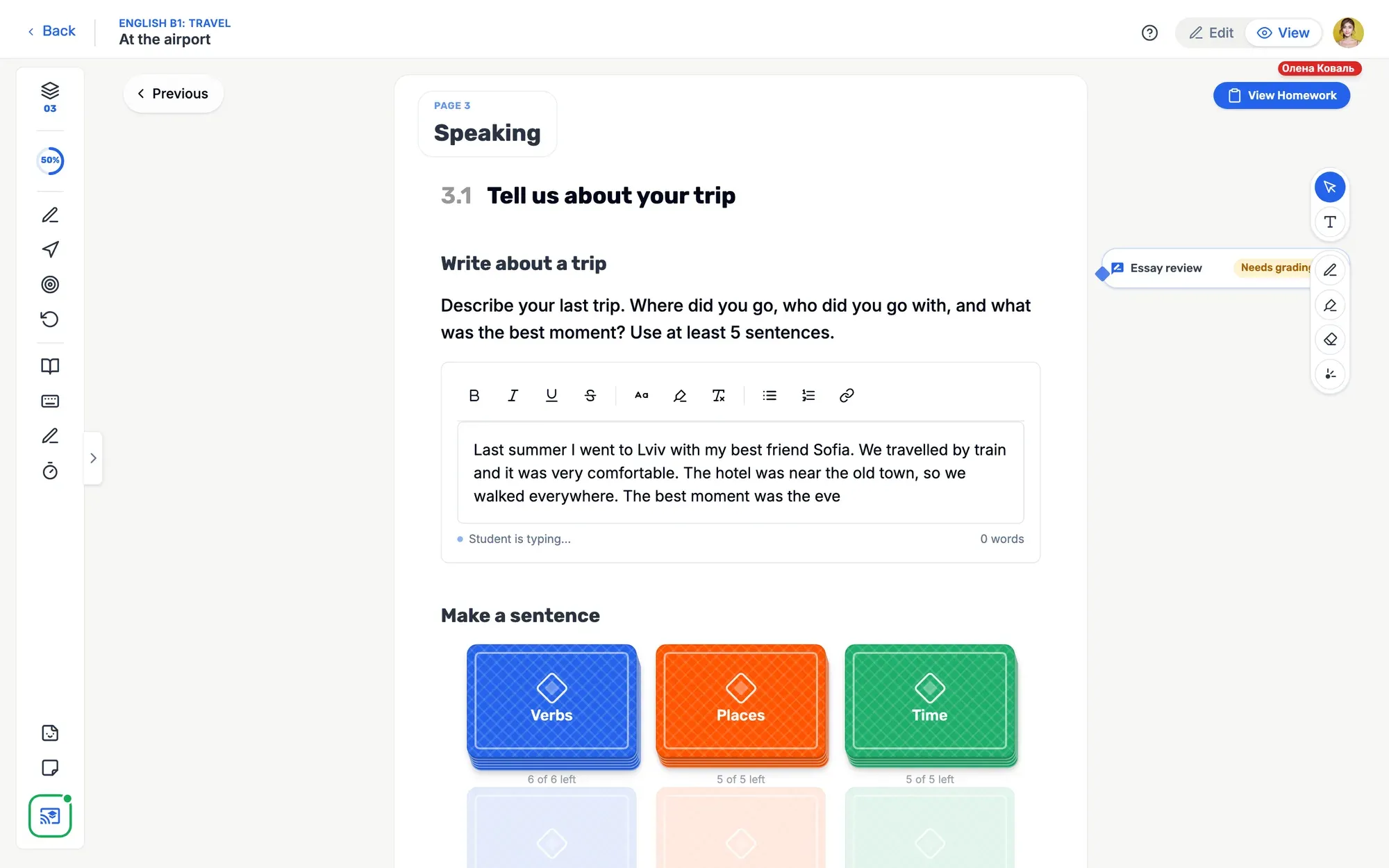
Writing feedback is slow partly because of logistics. In a verbios lesson with an essay block, you can watch the student’s text appear in real time during a live lesson (see watching essays being written), which lets you notice a repeating error and mention it while it is happening instead of three days later.
Live view of the essay as the student types it.
For homework, you can mark a submission as reviewed or send it back with a comment explaining what needs redoing. The student sees the comment, fixes the work and resubmits, and every round trip stays on the record so a second set of comments does not overwrite the first. That makes the revision step from the list above a normal part of the workflow. The AI feedback on essays can be set per student to a different language from the course: for example Ukrainian feedback on an English course, with corrections and quoted words staying in English. When the feedback stays in the course language, it is written one level simpler than the course. If a block is just for notes, you can turn off grading for it so it does not wait for a grade. For ideas on getting students to actually do homework, see homework students actually do. For plans and AI features, see the pricing page.
A 10-minute feedback routine for a lesson
After a speaking task in a 60-minute lesson:
- 2 minutes: write down 3-5 errors and 1-2 good sentences while the student speaks.
- 3 minutes: show them (sentences only), ask the student to find and fix the problem.
- 3 minutes: explain the one rule that appears most. Give two fresh examples.
- 2 minutes: the student says a corrected version of their original idea out loud.
Next lesson, start with one of those sentences again, a quick retrieval check that the correction held. For more on making that kind of check a habit, see how to teach vocabulary so it sticks, and for activities that give you something worth correcting, speaking practice ideas.
Common mistakes
- Correcting during a fluency task, so the student learns to say less.
- Interrupting on the first mistake, before you know whether it is a slip or a gap.
- Rewriting the student’s essay instead of marking it.
- Giving a grade with no next step.
- Correcting the same error forever without teaching the rule once, clearly.
Frequently asked questions
Should I correct every mistake a student makes?
No. Correcting everything interrupts fluency and overwhelms the student. Pick a focus before the activity: during fluency work correct only what blocks understanding, and note the rest for later. In writing, choose two or three recurring error types per piece.
What is a recast?
A recast is when you repeat what the student said in a correct form without stopping to explain. Student: "Yesterday I go to the cinema." Teacher: "Oh, you went to the cinema. What did you see?" It keeps the conversation moving, but some students do not notice the change, so it works best combined with other methods.
Should I give feedback in English or in the student's language?
It depends on level. At A1-A2 explanations in Ukrainian are often clearer and save time. From B1 up, feedback in simple English keeps students in the language, with Ukrainian for the one or two points that really need it. Whatever you pick, keep corrections themselves in English.