14 speaking activities for English lessons, 1:1 and groups
A speaking activity is only as good as the reason to talk. “Discuss your weekend” gives a confident student a chance to chat and a nervous one a way to say three words and stop. The activities below each give the student a specific job to do, with a prompt you can use tomorrow. Levels are CEFR (A2 elementary, B1 intermediate, B2 upper-intermediate, C1 advanced), and each one works one-to-one unless marked otherwise.
Warm-ups that get students talking (A2–B1)
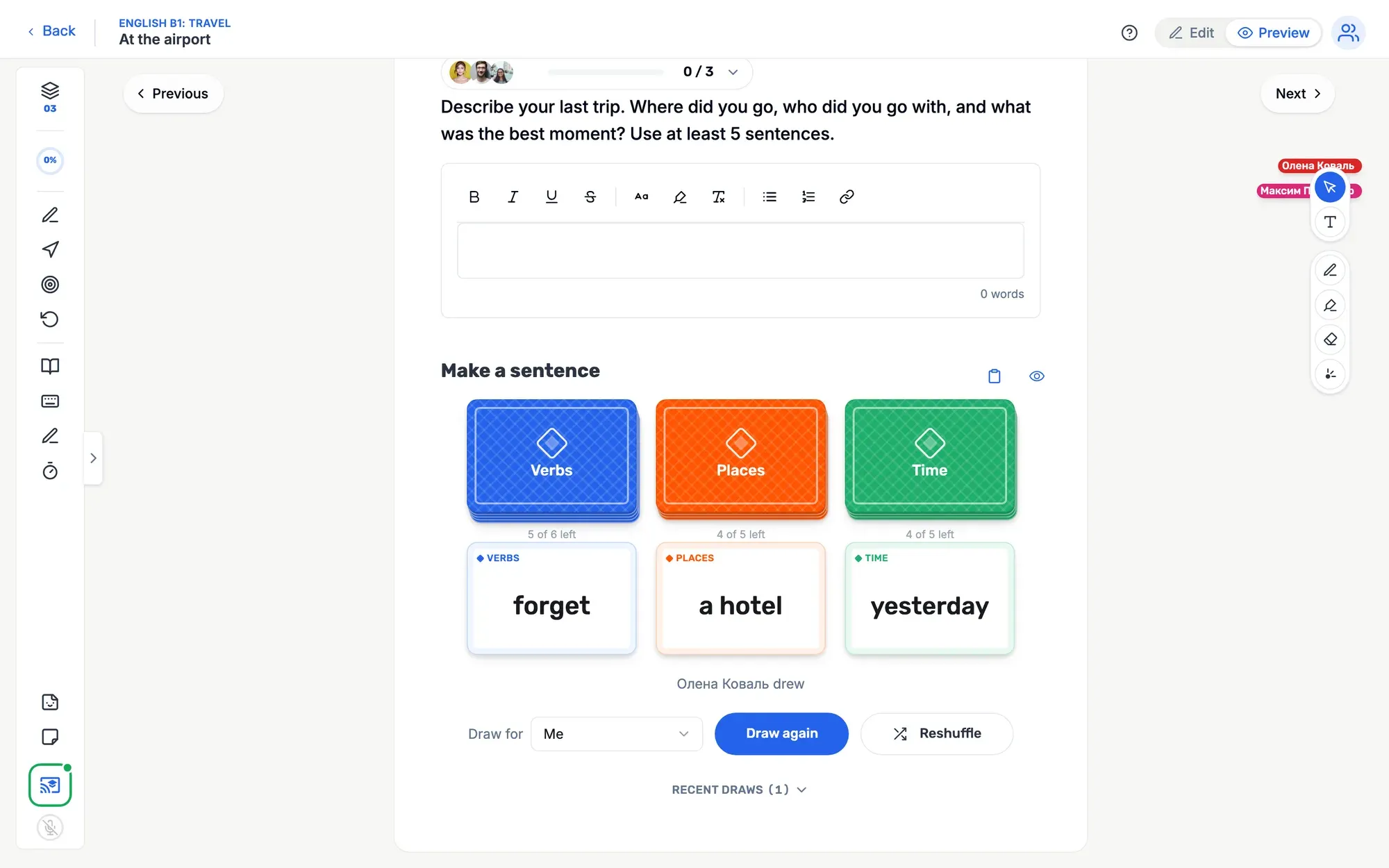
1. Three-card sentence. Prepare three small lists: verbs (catch, miss, book), places (the train station, a hotel) and times (in July, last week). The student draws one from each and builds a sentence or a short story. “I missed the train at the station last week.” Students who are afraid of an empty page like this because the starting material is given. In verbios, card decks do exactly this: up to four decks, one card from each deck per Draw, cards do not repeat until a deck runs out, and in groups everyone sees the same draw with the student’s name.
Draw a verb, a place and a time, then build a sentence.
2. Two truths and a lie. The student says three statements about themselves. You guess which is the lie by asking questions. Great for practicing past simple and question forms. Level A2–B1.
3. Five-minute chain story. You say the first sentence (“Last Saturday, Anna found a key in her bag.”). The student adds one, you add one, and so on, for ten turns. At B1 ask for linking words (suddenly, after that, in the end).
4. Rapid questions. Give a topic (“food”) and ask fast questions, one after another, for sixty seconds. Then swap roles: the student asks you. The goal is quick, natural responses, not perfect sentences.
Opinions and discussion (B1–B2)
5. Opinion scale. Put a statement on a line from “strongly agree” to “strongly disagree”, for instance “Homework should be banned” or “Working from home is better for everyone”. Student and teacher each place a pin and explain it. The value is that a pin is a position, so the student has something to defend. In verbios the opinion scale is a lesson exercise where, in a live lesson, every pin is visible to teacher and students and updates in real time.
6. Would you rather. “Would you rather live in a big city with no car, or in a village with a big garden?” Give a minute of silent thinking, then the student must give two reasons. Use “because” and “so” for B1, “whereas” and “on the other hand” for B2.
7. Ranking. Give a list of eight items (for example, things to take to a desert island) and ask the student to choose the top three and justify. In groups, pairs agree on one list and present it. The disagreement is the speaking practice.
8. Debate with assigned sides. Assign the position, regardless of the student’s own opinion (“You must argue that cities should ban cars.”). This frees students from having to share personal opinions and pushes B2 students into more complex language. Give three minutes of preparation and let them use notes of key words, not sentences.
Describing and explaining (A2–B2)
9. Picture description. Show a picture for thirty seconds, hide it, and ask the student to describe it from memory. Then show it again to compare. At A2 expect “there is/there are” and prepositions. At B2 ask for speculation: “She might be waiting for someone. It looks like it could be winter.”
10. Spot the difference, spoken. Two images, one for the teacher and one for the student, which only the owner sees. They ask each other questions to find five differences. This is an information gap, which means the conversation has a genuine purpose. Send each picture privately beforehand, in the chat or by message, so neither side sees the other’s.
11. Explain it simply. The student explains something they know well (how to cook borshch, how a video game works) to someone who has never heard of it. Add a constraint, such as “no more than two minutes, and no words in Ukrainian”. At C1, make it more abstract: explain a concept from their work.
Role plays and real tasks (A2–C1)
12. Situational role play. Give each person a card with their role and goal. For A2: customer and waiter, where the customer has a food allergy. For B1: calling a hotel to change a booking. For B2: a job interview where the teacher plays a difficult interviewer. For C1: negotiating a deadline with a client. Keep the goals in conflict, because a conflict makes the dialogue longer and more natural.
13. Problem-solving. “Your flight is canceled and the next one is tomorrow. You have a meeting at 9 a.m. What are your options?” The student proposes, you object. At B2–C1 this produces conditionals and modal verbs.
14. Short presentation. Give a topic and a random constraint. Three minutes, three points, one example each. Record it with the student’s consent and let them listen once. At exam level (C1) this mirrors the monologue tasks in many speaking exams.
Making random prompts less random
A random prompt takes the burden of choosing off the teacher and the student, and it adds a bit of playfulness. Cards, dice, a spinning wheel and a list of numbered topics all work. Keep your own prompt bank in a document and pull from it. If you do not have the time to write forty prompts, ask an AI tool for twenty prompts at B1 on the topic of travel and edit them. verbios card decks include a “Generate from AI” button: you copy a prompt, paste it into the AI of your choice, then paste the answer back so the decks fill in. Spin the Wheel sits next to card decks in the same menu for picking names or topics.
A 45-minute speaking lesson
For a B1 student:
- 0–5 minutes: warm-up (activity 1 or 3).
- 5–15 minutes: input (a short text or video), plus two or three useful phrases.
- 15–30 minutes: the main task (activity 5 or 12), with the student preparing for two minutes first.
- 30–40 minutes: second attempt of the same task, with improvements (the repetition is what raises quality).
- 40–45 minutes: delayed correction, with three sentences from the lesson. See how to correct mistakes.
For group lessons, see teaching online groups. For vocabulary that recycles through speaking, see how to teach vocabulary so it sticks.
Measuring how much students really talk
A frequent surprise for new teachers is how much teacher talk time there is. If you speak for most of the lesson, the student is not practicing speaking. The student should talk for more than half of the lesson. A quick check: record one lesson (with your student’s permission) and listen for who is speaking.
Common mistakes
- Choosing a topic the student has nothing to say about. Ask what they like first.
- Correcting every error mid-sentence. Save it for after.
- Skipping the preparation time. Even one minute of silence makes the answer better.
- Doing the activity once. Repeating it with a new partner or a new angle is where the improvement happens.
Frequently asked questions
How do I get a shy student to speak?
Lower the stakes. Give thinking time before answering, start with structured tasks like building a sentence from three cards, and let the student rehearse in writing first. Praise the message before correcting the form, and keep corrections for after the activity.
How long should a speaking activity last?
Most work well at 5–10 minutes in a 45–60 minute lesson. Role plays and discussions can run 10–15 minutes. A short activity done with a clear goal beats a long, vague one.
How do I keep a group from being dominated by one student?
Use structure that gives everyone a turn: a draw that picks the speaker, pair work before whole-group feedback, or a rule that each person adds one idea before anyone speaks twice.